Context
Historians conventionally date the Viking Age from the raid on Lindisfarne in 793 to the Battle of Stamford Bridge in 1066, though Scandinavian expansion both preceded and outlasted those markers. The underlying drivers were demographic pressure, political fragmentation in target regions, and access to maritime technology that gave Norse groups a decisive advantage in mobility. Clinker-built longships, shallow-draughted enough to navigate rivers yet seaworthy enough to cross open ocean, were the enabling infrastructure of the entire phenomenon. Their construction—overlapping planks riveted to a flexible keel—combined lightness with resilience, allowing crews to portage vessels overland between river systems and thereby penetrate deep into continental interiors.
Trade was as central as warfare. Emporia—seasonal or permanent market towns—emerged at strategic nodes along coasts and river systems. Hedeby, on the Jutland peninsula near the modern Danish–German border, became one of the largest and most cosmopolitan of these centres by the ninth century, linking North Sea commerce with Baltic and overland routes into Slavic and Frankish territories. Birka in Sweden and Kaupang in Norway served analogous roles, each functioning as a hub where raw materials from the Scandinavian hinterland were exchanged for luxury goods from further afield. Further east, the settlement at Truso, near present-day Elbląg in Poland, connected Scandinavian traders with the amber-rich southern Baltic coast and the river routes leading towards Byzantium and the Abbasid Caliphate. These sites were not merely stopping points; they were nodes of craft production, currency exchange, and cultural encounter where Norse, Slavic, Frankish, and even Arabic material culture mingled freely.
Settlement followed trade. Norse communities established themselves permanently across the British Isles, Normandy, Iceland, Greenland, and briefly in North America. The Danelaw in England and the earldom of Orkney illustrate how military conquest could crystallise into lasting political structures, while Iceland's Althing, founded around 930, represents one of the earliest parliamentary assemblies in European history. In each case, the pattern was similar: initial contact through raiding or commerce gave way to more durable forms of political and social integration.
What to Notice
The material evidence of the Viking Age rewards close attention because it reveals the sophistication behind what popular culture often reduces to brute force. Two visual anchors are especially instructive.
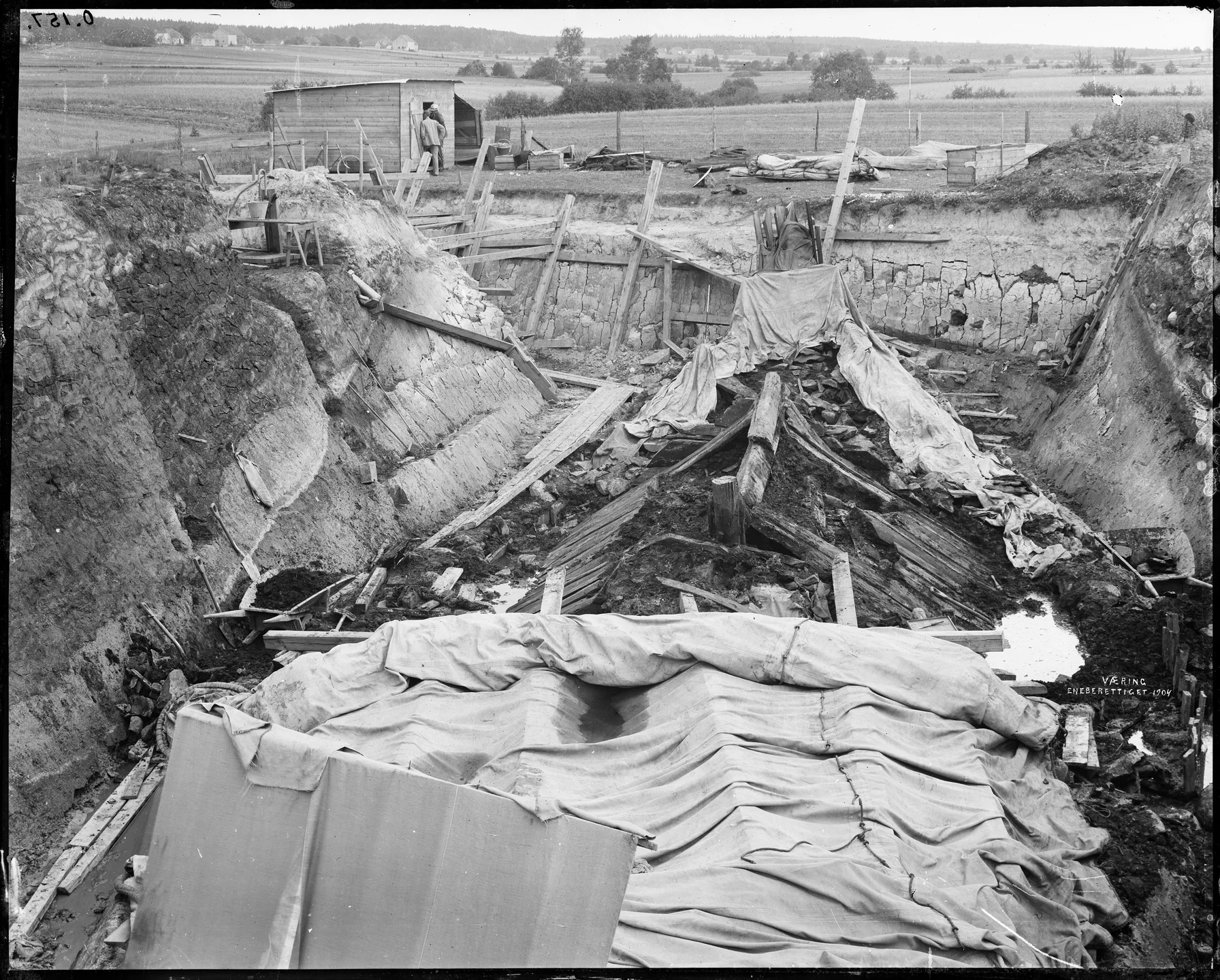
The 1904 excavation of the Oseberg ship, captured in a celebrated historic photograph, shows the vessel emerging from its burial mound near Tønsberg in southern Norway. Discovered beneath a thick layer of blue clay that had preserved the oak timbers in extraordinary condition, the ship dates to approximately 834 and was used as a burial chamber for two women of high status. What the excavation image reveals is the sheer scale of the craft—over twenty-one metres long—and the elaborate carved prow that signals its function as a prestige object as much as a seagoing vessel. The Oseberg ship also yielded textiles, sledges, a cart, and animal-head posts of remarkable artistic quality, making it one of the richest archaeological discoveries in Northern Europe. The photograph itself is a document of early twentieth-century field archaeology, showing the painstaking manual labour required to free the hull from compacted earth. As a single find, the Oseberg burial encapsulates the interplay of craftsmanship, ritual, and social hierarchy that characterised elite Viking Age culture.
A digital reconstruction of the trading settlement at Truso offers a complementary perspective. Produced by the Archaeological and Historical Museum in Elbląg, the visualisation depicts a cluster of timber buildings arranged along a waterfront, with jetties extending into the shallow waters of a former lake. Truso was mentioned by the Anglo-Saxon traveller Wulfstan in the late ninth century and has been identified through excavation with a site at Janów Pomorski. The reconstruction conveys the modest, functional architecture of a Viking Age emporium: no monumental stone, but densely packed workshops where craftspeople worked amber, antler, and metal. Trade goods recovered from the site include Arabic dirhams, glass beads, and weights conforming to Scandinavian standards, confirming Truso's role as a junction between western and eastern exchange systems.
Together, these two anchors—one a burial of conspicuous wealth, the other a workaday commercial settlement—illustrate the twin poles of Viking Age society: elite display and pragmatic commerce, both sustained by mastery of waterborne movement.
Points of Interest
The reach of Viking networks is confirmed by small, portable objects found far from Scandinavia. A fragment of a cast copper-alloy mount, dating to between roughly 1000 and 1100 and recovered in Suffolk, England, exemplifies the kind of decorative metalwork that circulated through Norse-influenced territories. Its open-work design and distinctive reddish-brown patina are consistent with Scandinavian artistic conventions, yet its findspot in East Anglia places it squarely within the Danelaw, where Norse and Anglo-Saxon material cultures blended over generations. Objects such as this remind us that the Viking Age was not only an era of dramatic voyages but also one of quiet, cumulative cultural exchange at the local level.
Runestones, raised across Scandinavia from the late tenth century onward, served as public memorials that recorded names, lineage, and sometimes the circumstances of death. Many commemorate individuals who died on expeditions abroad—in Greece, in England, or along eastern river routes—providing a first-person, if formulaic, testimony to the geographic ambition of the age. Their inscriptions, carved in the runic alphabet and often framed by elaborate serpentine ornamentation, remain among the most direct textual sources for understanding how Viking Age communities narrated their own experience of mobility and loss. Catalogued and studied by institutions such as Europeana, these monuments continue to yield fresh insights as digital imaging techniques reveal details invisible to the naked eye.