Context
Human settlement on the Acropolis rock dates to the Neolithic period, and Mycenaean fortification walls, parts of which survive beneath later masonry, confirm its strategic importance by the thirteenth century BCE. During the Archaic period the plateau became the principal sanctuary of Athena Polias, protectress of the city. An early limestone temple and a monumental predecessor to the Parthenon, sometimes called the Older Parthenon, were under construction when the Persians sacked Athens in 480 BCE. The destruction was total: columns were toppled, sculptures smashed, and the sacred precinct left in deliberate ruin as a memorial of barbarian sacrilege.
Reconstruction began in earnest after 449 BCE, when the Peace of Kallias eased military expenditure and Pericles redirected surplus tribute from the Delian League towards a building programme of unprecedented scale. The Parthenon was completed between 447 and 432 BCE; the Propylaia followed from 437 to 432 BCE; the Temple of Athena Nike was built around 427–424 BCE; and the Erechtheion was finished by approximately 406 BCE. The programme was not merely religious. It was a deliberate assertion of Athenian hegemony, financed by allied tribute and executed by a workforce that included citizens, metics, and enslaved labourers. The buildings were designed to be seen together — from the harbour at Piraeus, from the Agora below, and from the processional route of the Panathenaic Way that climbed the western slope. Every sightline was calculated, every material choice deliberate: Pentelic marble, quarried from Mount Pentelikon northeast of Athens, gave the monuments a warm, faintly golden luminosity that distinguished them from the grey limestone of earlier construction.
What to Notice
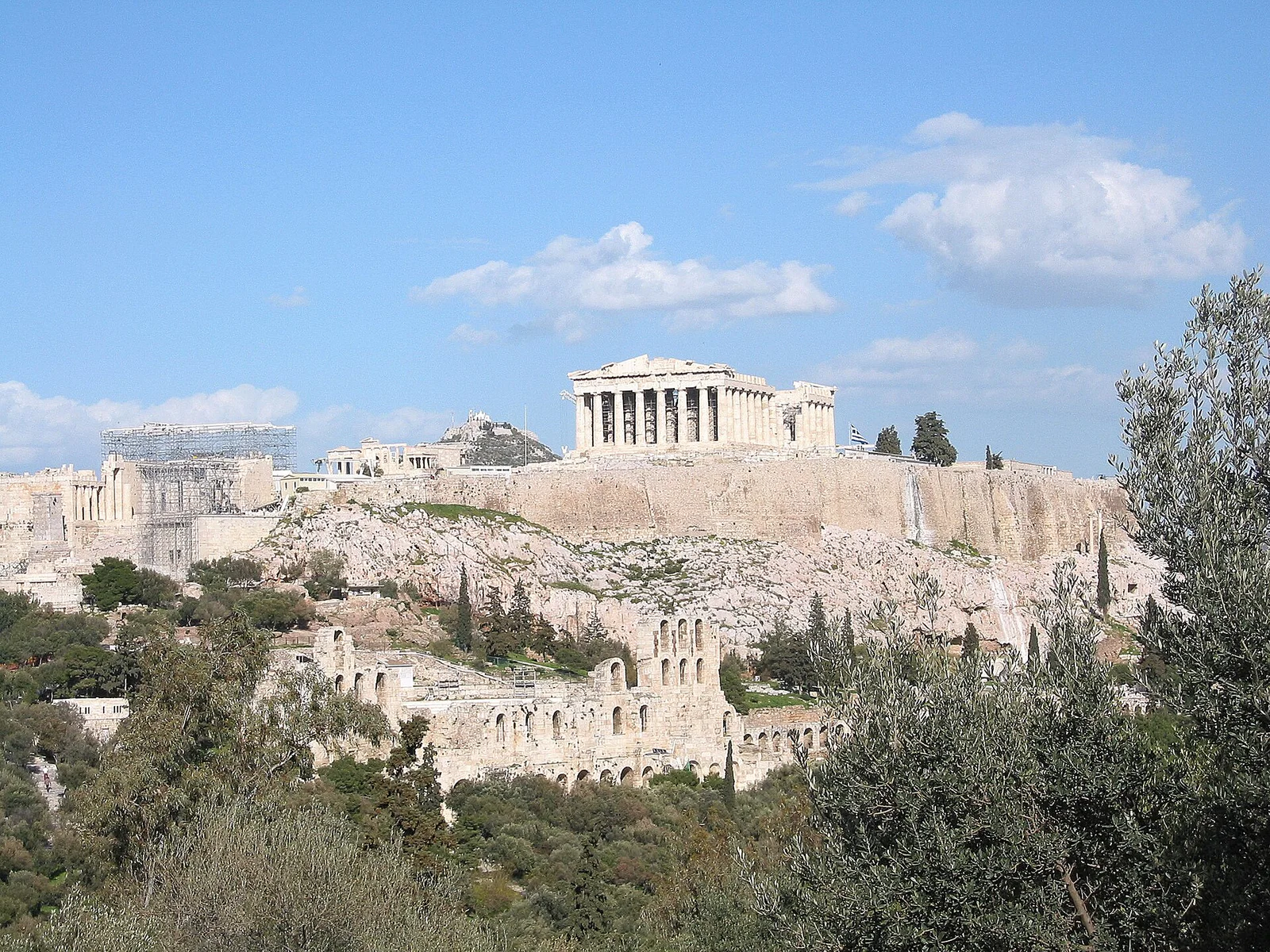
The most immediate visual impression of the Acropolis is its relationship to the city below. Seen from the south or west, the sacred rock rises as a sheer-sided plateau crowned by the Parthenon's colonnade, its mass dominating the urban fabric of modern Athens exactly as it dominated the ancient polis. The view of the Acropolis above the city makes this legible at once: the rock is not merely elevated ground but a deliberate stage, its vertical faces reinforced by retaining walls that amplify the natural cliff. The Parthenon sits at the highest point, oriented so that its western façade — the first seen by anyone approaching from the Propylaia — catches the afternoon light.
The western approach itself repays close attention. A broad panoramic view across the Propylaia reveals the ceremonial gateway as a building of considerable architectural ambition in its own right. Designed by Mnesikles, the Propylaia combined Doric and Ionic orders in a single structure, its central passageway aligned with the Panathenaic processional route. The asymmetry of its wings — the north wing larger than the south, possibly to avoid encroaching on the precinct of Athena Nike — demonstrates how Athenian architects negotiated between ideal geometry and the constraints of sacred topography. Flanking the approach, the small Temple of Athena Nike projects from the bastion at the southwest corner, its Ionic tetrastyle porches framing views towards Salamis, where the Persian fleet was defeated in 480 BCE.
Inside the sanctuary, the Erechtheion presents a radically different architectural logic. Its plan is irregular, accommodating multiple cults — Athena Polias, Poseidon-Erechtheus, and the legendary olive tree of Athena — within a single complex of interlocking chambers at different levels. The south porch is carried not by columns but by six draped female figures, the Caryatids, whose originals are now displayed in the Acropolis Museum. These figures, visible in the museum gallery, stand as some of the most refined examples of late-fifth-century sculptural integration with architecture: each bears the weight of the entablature on a cushion-like capital atop her head, her drapery articulated to suggest both structural solidity and organic movement. Their removal from the building to the controlled environment of the museum has preserved surface detail that weathering would have destroyed, but it has also severed them from the architectural context that gave them meaning.
Points of Interest
The Parthenon's sculptural programme was the most extensive of any Greek temple. The metopes depicted mythological combats — Lapiths against Centaurs, Gods against Giants — while the continuous Ionic frieze running around the exterior of the cella wall portrayed a procession widely interpreted as the Panathenaic festival. Sections of this frieze, visible in the Acropolis Museum's top-floor gallery, are displayed at the same height and orientation they occupied on the building, with natural light entering from the north to replicate ancient viewing conditions. The east pediment showed the birth of Athena; the west, her contest with Poseidon for patronage of Athens.
The Acropolis was never a static monument. Roman emperors added dedications; a Christian basilica was installed inside the Parthenon; Ottoman forces converted it into a mosque and used the Propylaia as a powder magazine. The Venetian bombardment of 1687 detonated that magazine and blew out the Parthenon's centre. Restoration work, ongoing since the 1970s under the Committee for the Conservation of the Acropolis Monuments, uses original marble blocks where possible and new Pentelic marble — distinguishable by its whiter tone — where structural integrity demands it. The discipline of this restoration is itself a statement about how the modern Greek state understands its relationship to the classical past.
Sources and References
For editorial verification and public reference, only whitelisted institutional sources with a direct link to the collection, object context, or relevant museum framing were retained.
Institutional sources consulted: