Context
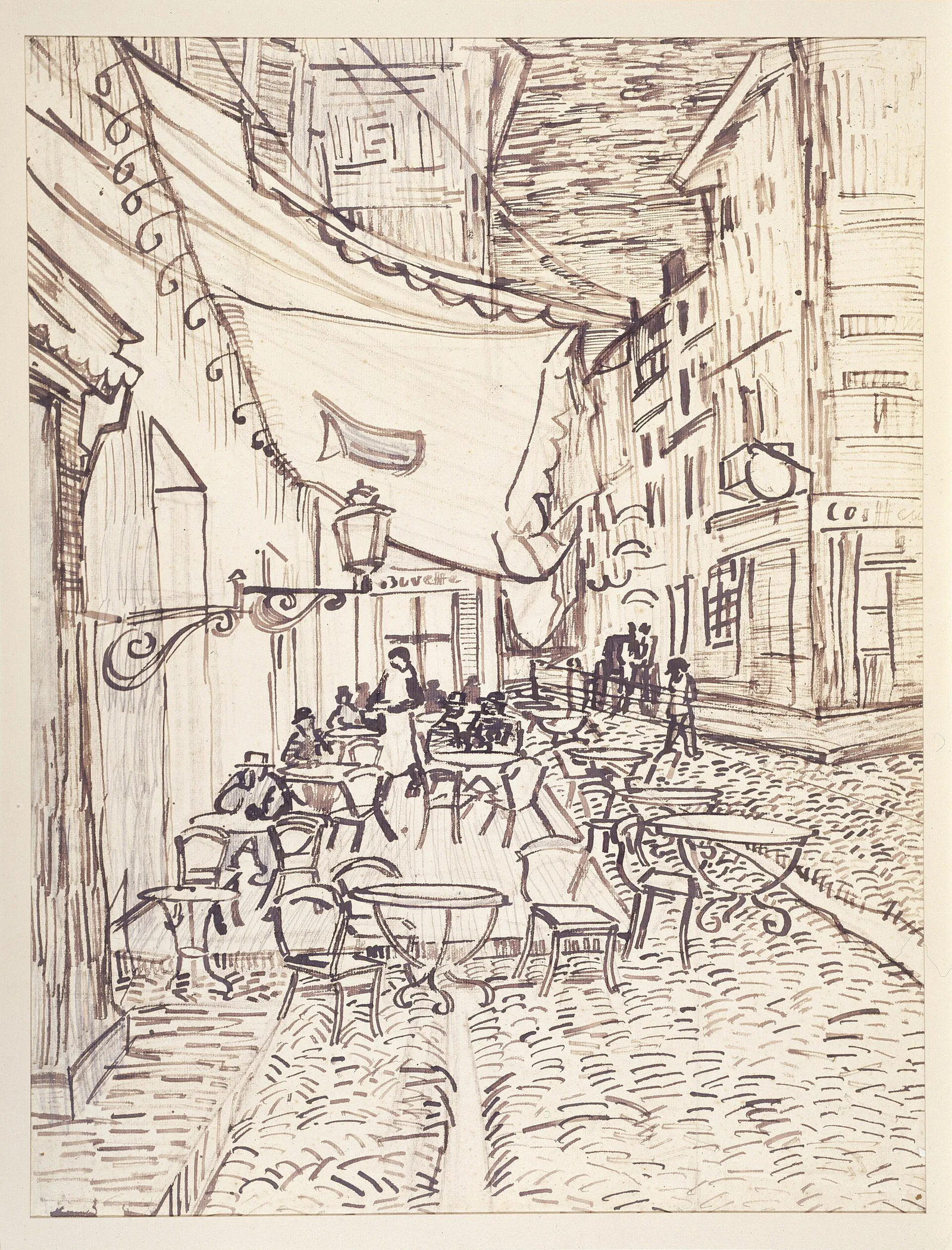
Van Gogh's fascination with nocturnal subjects crystallised during his time in Arles. In September 1888 he painted *Café Terrace at Night*, setting the warm glow of gas lamps against a deep blue sky studded with stars. That canvas, now in the Kröller-Müller Museum, was among the first works in which he attempted to render starlight with saturated colour rather than tonal darkness. Writing to his sister Wilhelmina, he insisted that the night was "much more alive and richly coloured than the day." The ambition was radical: to paint darkness without black.
The Arles period also produced *The Yellow House*, a depiction of the building Van Gogh rented and hoped to turn into a communal studio. Its sunlit façade, rendered in chrome yellow against a cobalt sky, encapsulates the optimism that preceded his breakdown. After the disastrous visit of Paul Gauguin and the ear-severing crisis of December 1888, Van Gogh voluntarily entered the asylum at Saint-Rémy in May 1889. There, confined but permitted to paint, he returned to the night sky with renewed urgency.
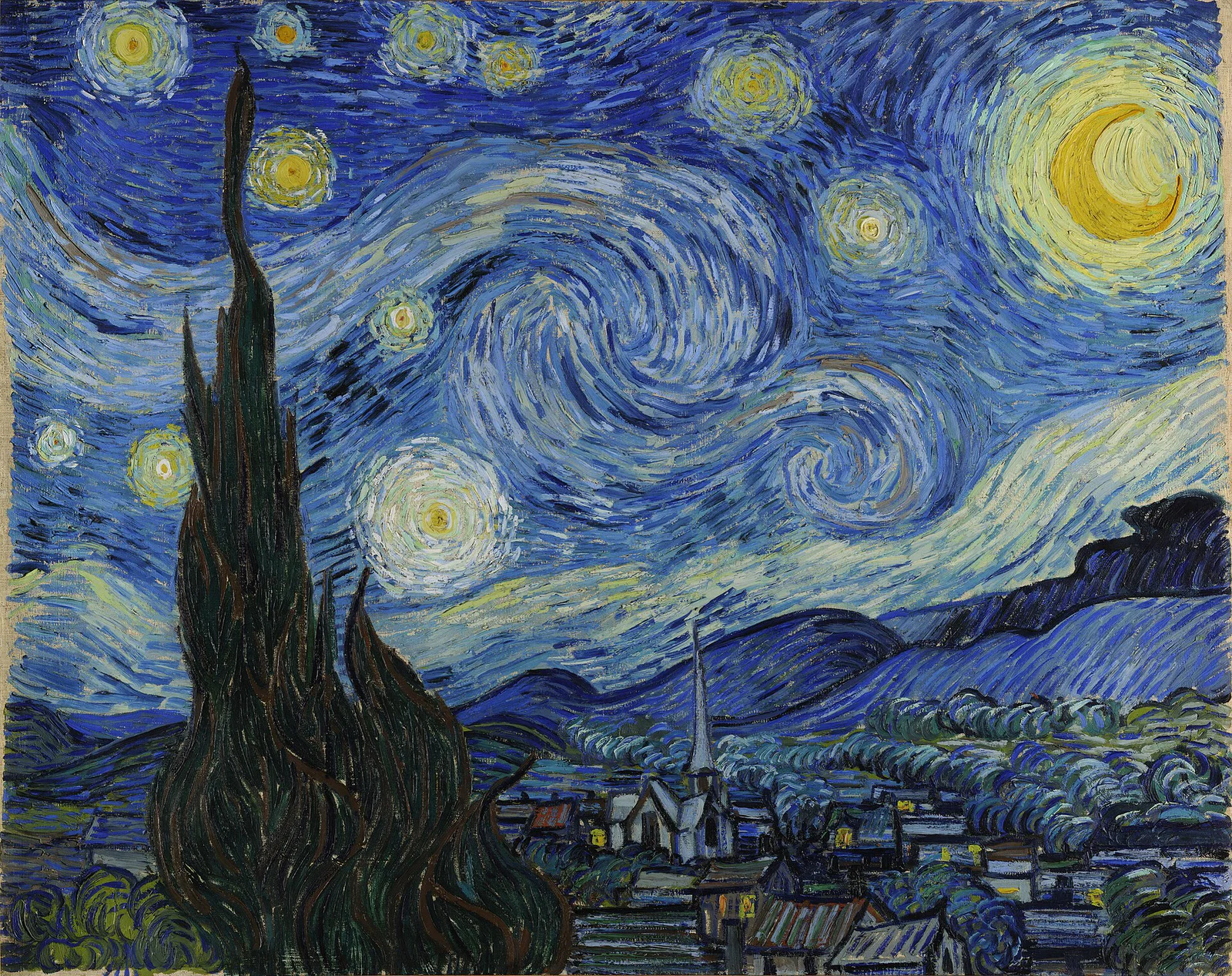
*The Starry Night* was completed within weeks of his arrival. Unlike the Arles nocturnes, which were painted outdoors, this canvas was worked up in the studio from memory and sketches, giving Van Gogh greater freedom to reshape the composition. The result is neither pure landscape nor pure fantasy but a synthesis governed by emotional logic. He described the painting to his brother Theo with notable ambivalence, calling it a study rather than a finished picture, and expressing doubt about its "exaggerations." That uncertainty did not prevent him from returning to the motif: a related drawing and further night studies followed throughout the summer.
What to Notice
The painting's surface rewards sustained attention. Van Gogh applied thick, directional brushstrokes of oil paint in rhythmic patterns that vary across the canvas. The sky is dominated by concentric whorls of blue, white, and yellow that spiral outward from eleven luminous stars and a crescent moon. These vortices are not decorative flourishes; they create a sense of atmospheric motion, as though the air itself were a visible, pulsating medium. The impasto is heaviest in the stars, where ridges of lead-white and chrome-yellow pigment catch real light and appear to glow.
Below the sky, a dark cypress tree rises like a flame at the left edge, its form built from vertical strokes of deep green, blue, and black. Cypresses became a near-obsession during the Saint-Rémy months. In *Wheat Field with Cypresses*, painted the same summer and now held by the Metropolitan Museum of Art, Van Gogh placed similar towering trees against a turbulent sky above golden grain. Comparing the two canvases reveals how he adapted the same motifs—swirling clouds, dark verticals, luminous horizons—to different emotional registers: cosmic drama in *The Starry Night*, pastoral intensity in the wheat field.
The village nestled in the valley is rendered with smaller, more controlled strokes, its blue rooftops and lit windows suggesting quiet domesticity beneath the sky's upheaval. The church spire, taller and more pointed than anything in the actual Saint-Rémy landscape, anchors the composition vertically and introduces a note of northern memory—possibly recalling churches Van Gogh knew in the Netherlands and Belgium. The rolling hills beyond echo the Alpilles range visible from the asylum, their contours softened into undulating ribbons of blue and green.
Colour relationships are carefully orchestrated. The complementary pairing of blue and orange-yellow generates optical vibration, while the green-to-violet transitions in the hills provide a cooler counterpoint. Van Gogh's palette here is darker and more complex than in his Arles work, reflecting both the nocturnal subject and a shift in emotional temperature.
Points of Interest
Van Gogh produced roughly 150 paintings during his year at Saint-Rémy, many of them among his most celebrated works. The asylum's walled garden, olive groves, and surrounding wheat fields furnished a limited but fertile repertoire of subjects. His practice of copying prints by other artists also intensified; Jean-François Millet's compositions were a particular touchstone, and Van Gogh reinterpreted Millet's *Starry Night* (a very different image of two figures walking beneath a faintly lit sky) in his own idiom.
The painting's posthumous fame grew slowly. Acquired by the poet and collector Julien Leclercq, then by the dealer Émile Schuffenecker, it passed through several hands before entering the Museum of Modern Art's collection in 1941. Its status as a cultural icon accelerated in the second half of the twentieth century, reproduced on everything from posters to postage stamps. Scholars continue to debate the astronomical accuracy of the sky, the possible influence of Japanese woodcuts on the swirling forms, and the degree to which the painting reflects Van Gogh's psychological state. Each reading adds a layer without exhausting the image.
Sources and References
For editorial verification and public reference, only whitelisted institutional sources with a direct link to the collection, object context, or relevant museum framing were retained.
Institutional sources consulted: