Context
The sculptures in question once formed part of the Parthenon's exterior programme: a continuous Ionic frieze depicting the Panathenaic procession, metopes illustrating mythological battles, and pedimental groups representing the birth of Athena and her contest with Poseidon. Together they constituted one of the most ambitious decorative schemes of the Classical period, executed between roughly 447 and 432 BCE. The frieze alone stretched for some 160 metres around the inner colonnade, an unprecedented feat of narrative relief carving that united hundreds of human and animal figures in a single, flowing composition.
Thomas Bruce, seventh Earl of Elgin, obtained a firman from the Ottoman authorities governing Athens in 1801, permitting him to make casts and drawings of the Acropolis monuments. The precise scope of that document remains contested: Elgin's agents interpreted it as licence to remove sculptural elements wholesale. Between 1801 and 1812, approximately half the surviving frieze, fifteen metopes, and substantial portions of both pediments were detached, shipped to Britain, and eventually sold to the British government in 1816. They have been displayed in the British Museum ever since, currently occupying a purpose-built gallery—the Duveen Gallery—that opened in 1962. The gallery's design, with its elongated plan and overhead natural light, was conceived specifically to present the marbles as masterpieces of Western art, a framing choice that has itself become part of the debate.
Greece has sought the marbles' return almost continuously since independence in 1832. The campaign intensified after 1982, when the actress and politician Melina Mercouri, then Minister of Culture, brought the issue before UNESCO. The opening of the Acropolis Museum in 2009, with a top-floor gallery designed to reunite the surviving frieze in its original spatial sequence, removed one of the British Museum's longstanding arguments—that Athens lacked a suitable facility. Diplomatic discussions have continued into the 2020s, with reports of behind-the-scenes negotiations surfacing periodically, though no formal agreement has been reached. The impasse has made the Parthenon Marbles a touchstone for broader restitution conversations affecting collections worldwide.
What to Notice
Viewing the marbles in the British Museum's Duveen Gallery offers a particular kind of encounter. In the panoramic installation visible in photographs of the gallery's long, skylit hall, the frieze slabs are mounted at roughly eye level along both lateral walls, while metopes and pedimental figures occupy the shorter ends. The cool, even lighting and pale walls isolate each relief against a neutral ground, encouraging close formal analysis of drapery folds, musculature, and the shallow carving technique that creates an illusion of depth from only a few centimetres of stone. One wide-angle view—taken from the centre of the gallery looking towards the pedimental sculptures—reveals how the display privileges individual aesthetic impact: each slab is separated by a visible gap, and the visitor reads the procession as a sequence of discrete panels rather than as a continuous architectural band. The effect is undeniably powerful, yet it severs the sculptures from the architectural rhythm for which they were designed.
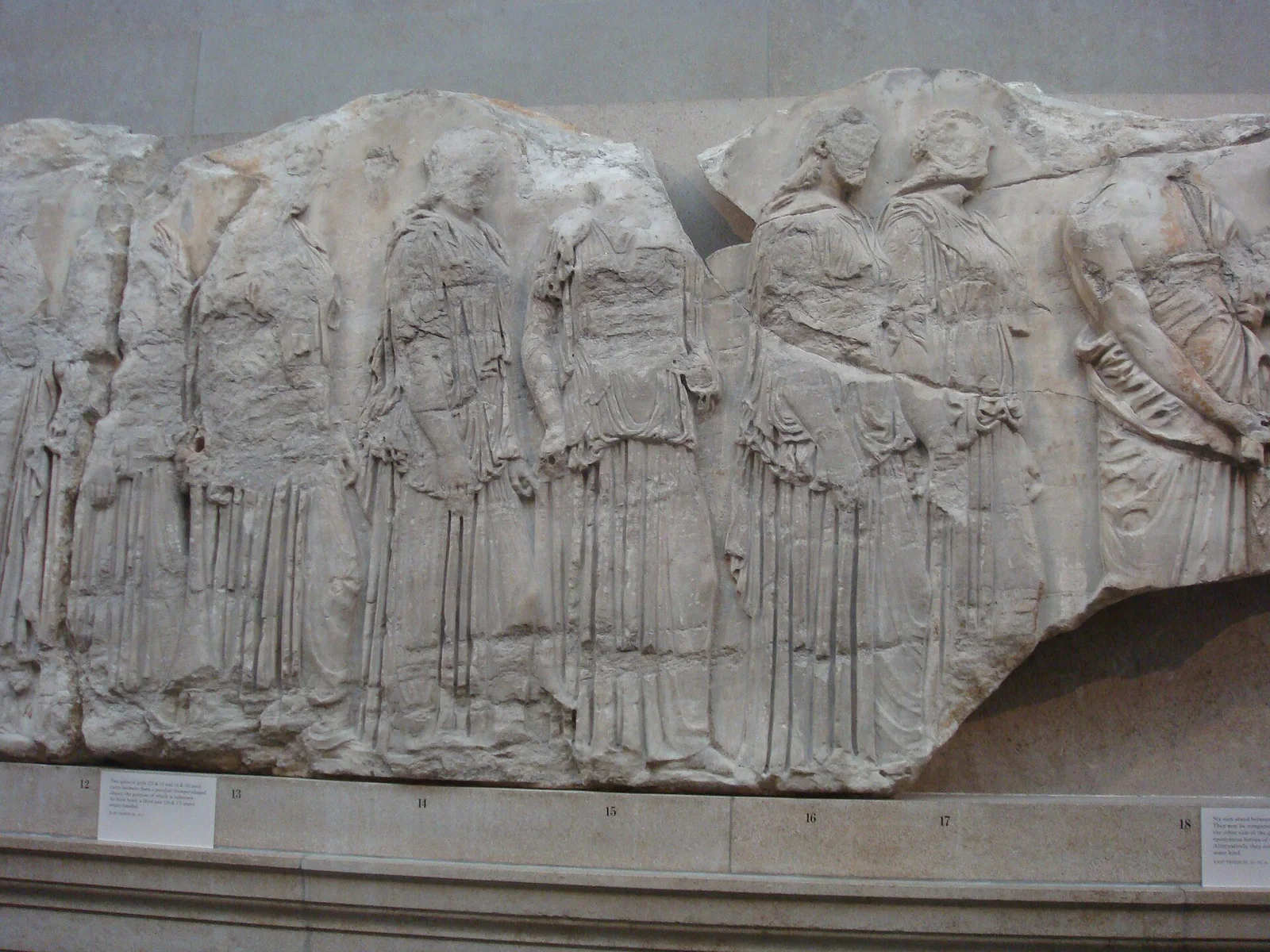
A second, tighter photograph of the frieze slabs shows the characteristic surface condition of the London marbles. Decades of controversial cleaning—most notoriously in the 1930s, when museum staff used copper chisels and carborundum to strip the stone—left many surfaces whiter and flatter than their Athenian counterparts. The warm honey-coloured patina visible on fragments still in Athens is largely absent here, a material record of institutional decisions that themselves became part of the restitution debate. For conservators and art historians alike, the altered surfaces raise uncomfortable questions about what constitutes responsible care and whether the pursuit of an idealised whiteness distorted the sculptures' historical legibility.
Contrast this with the graphite sketch held by the Smithsonian, drawn by the American landscape painter Frederic Edwin Church during a visit to Athens in April 1869. Church's composition places the Parthenon in its topographical setting: ruinous column drums and shattered blocks litter the foreground, while the temple stretches horizontally across the middle distance. Two isolated, damaged columns at centre mark the epicentre of the 1687 Venetian bombardment that blew out the building's core. The sketch captures a moment when the Parthenon was still an open ruin, its remaining sculptures exposed to weather and conflict—precisely the condition Elgin's defenders cite to justify removal. Read alongside the museum photographs, Church's drawing complicates any simple narrative: it shows both the vulnerability of the monument and the integral relationship between sculpture and site that restitution advocates seek to restore.
Points of Interest
The Parthenon Marbles are not the only fragments of the temple's decoration held outside Greece. The Metropolitan Museum of Art in New York possesses a marble fragment from the building's architectural programme, while the Louvre, the Vatican Museums, and several smaller European collections hold additional pieces. This dispersal means that full reunification would require multilateral negotiation, not merely a bilateral agreement between London and Athens—a logistical and diplomatic reality that is often overlooked in public discussion of the controversy.
The British Museum Act of 1963 prohibits the trustees from permanently deaccessioning objects except under narrow conditions, a legal barrier frequently cited in parliamentary debate. Proposed workarounds have included long-term loans, cultural-exchange frameworks, and even new primary legislation—none yet enacted. Meanwhile, the Acropolis Museum's Parthenon Gallery displays original blocks alongside plaster casts of the missing sections, making the absence itself a curatorial statement: the gaps are the argument. Visitors walking around that gallery experience the frieze as an architectural whole for the first time in modern memory, with the blank white casts serving as silent reminders of what remains in London. It is a display strategy that turns incompleteness into eloquence, and it has shifted the terms of the debate more effectively than any diplomatic communiqué.
Sources and References
For editorial verification and public reference, only whitelisted institutional sources with a direct link to the collection, object context, or relevant museum framing were retained.
Institutional sources consulted: