Context
Khufu inherited a tradition of monumental stone construction that had evolved rapidly across barely a century. His father Sneferu experimented at Meidum, Dahshur, and the Red Pyramid, refining the geometry of true pyramids through costly trial and error. By the time Khufu's architects began work at Giza, the technical vocabulary — quarrying, sledge transport, ramp systems, precision surveying — was mature enough to attempt a structure on an unprecedented scale. The base covers roughly 5.3 hectares, its sides aligned to true north within a fraction of a degree. The core masonry rises in approximately 210 courses to an original apex height of about 146.6 metres, clad in fine Tura limestone that once gave the monument a brilliant white sheen visible from across the delta.
The workforce was not, as popular myth long held, composed of slaves. Archaeological evidence from the workers' village south-east of the plateau — excavated by Mark Lehner and Zahi Hawass from the 1990s onward — reveals a rotating labour force of perhaps 20,000 to 30,000 men, organised into named gangs, fed on cattle, bread, and beer, and buried in modest tombs near the site. Graffiti inside relieving chambers above the King's Chamber record gang names such as "Friends of Khufu," confirming the project's integration into the state's administrative and ritual economy.
Internally, the pyramid contains three principal chambers: the subterranean chamber cut into bedrock, the so-called Queen's Chamber at a mid-level, and the King's Chamber high in the superstructure, roofed with nine granite slabs weighing up to eighty tonnes each. The Grand Gallery, a corbelled passage nearly forty-seven metres long, remains one of the most impressive interior spaces in all ancient architecture. Recent muon-tomography surveys have identified a large void above the Grand Gallery, the purpose of which is still debated.
What to Notice
Photographs of the Great Pyramid taken across different eras and seasons reveal how profoundly context shapes perception. In Francis Frith's 1857 albumen print — held by the Art Institute of Chicago and titled *The Sphynx and the Great Pyramid, Geezeh* — the monument looms behind the half-buried Sphinx in a landscape stripped of almost every modern intrusion. The print's tonal range, characteristic of early wet-collodion photography, renders the limestone in soft gradations of sepia, compressing the pyramid's mass into a flat, almost abstract triangle. Frith's composition deliberately pairs the two icons, yet the Sphinx's body is still engulfed in sand up to its shoulders, a reminder that systematic clearance of the plateau did not begin until the late nineteenth century. The image captures a moment when European audiences were constructing their own romantic vision of Egypt, and the photograph itself became a vehicle for that projection.
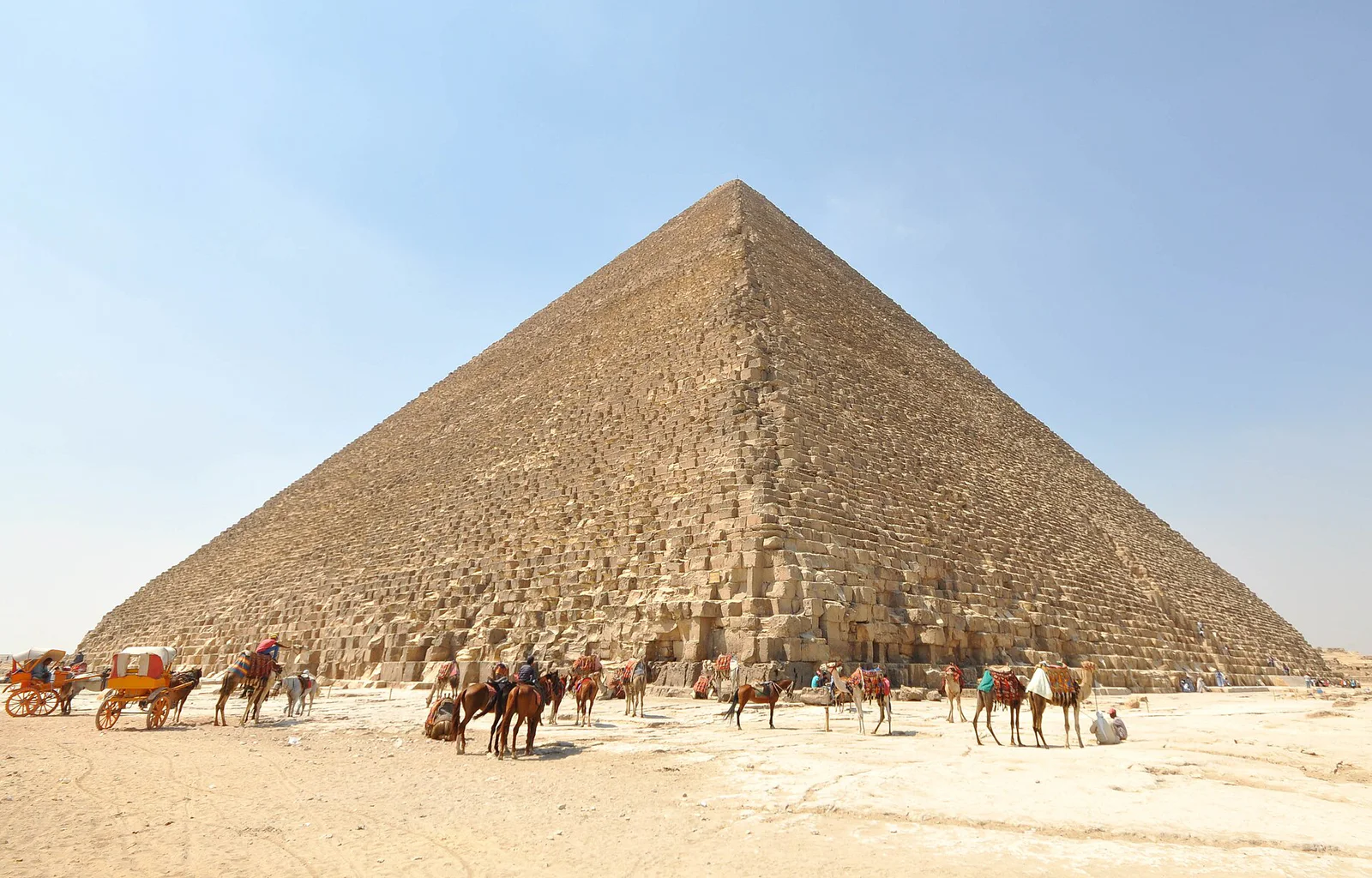
By contrast, a contemporary view showing domesticated dromedary camels resting at the pyramid's base reintroduces scale and lived reality. The animals, still used for tourist transport, provide a bodily measure against the lowest courses of masonry, each block roughly waist-high on a standing adult. The warm, sandy tonality of the stripped core stones — long since denuded of their Tura casing — dominates the surface, and the stepped profile that results is now the pyramid's most recognisable silhouette, quite different from the smooth, gleaming form Khufu's subjects would have known.
A further shift in register appears in images from the 2021 *Forever is Now* exhibition, which placed contemporary art installations directly on the Giza Plateau. Seen against the pyramids at dusk, these sculptural interventions dramatise the tension between ancient permanence and modern ephemerality. The warm amber light of the desert sunset unifies old and new forms, yet the contrast in material — polished metal and resin against weathered limestone — underscores how radically the pyramid's cultural function has changed: from sealed royal tomb to open-air gallery backdrop.
Points of Interest
The pyramid's orientation is remarkably precise. Recent research suggests the builders may have used the autumn equinox shadow method or circumpolar star alignments to achieve their near-perfect north–south axis. Either technique would have required sustained, careful observation over multiple nights or days, implying a dedicated surveying priesthood.
The so-called "air shafts" extending from both the King's and Queen's Chambers have attracted decades of speculation. The northern shaft of the King's Chamber points towards the celestial pole, while the southern shaft aligns with the belt of Orion — associations that resonate with Pyramid Text spells describing the king's ascent to the imperishable stars. Whether these shafts served a ventilation function, a ritual sighting purpose, or both remains unresolved.
Khufu's own funerary boat, discovered dismantled in a sealed pit south of the pyramid in 1954, was reassembled and is now displayed in the Grand Egyptian Museum. Built of Lebanese cedar, the vessel measures over forty-three metres and may have been intended to carry the king's spirit across the celestial waters.
Sources and References
For editorial verification and public reference, only whitelisted institutional sources with a direct link to the collection, object context, or relevant museum framing were retained.
Institutional sources consulted: