Context
Qin Shi Huang (r. 221–210 BCE) unified the warring states of China into a single centralised empire, standardising weights, measures, currency, and script. His reign inaugurated the Qin dynasty, which, though short-lived, established administrative templates that endured for centuries. The emperor's mausoleum complex at Lintong, roughly thirty-five kilometres east of modern Xi'an, was conceived as a microcosm of his earthly domain. Ancient historian Sima Qian, writing about a century after the emperor's death, described a tomb furnished with rivers of mercury, celestial maps on the ceiling, and elaborate mechanical defences—claims that modern soil analysis has partially corroborated through elevated mercury readings at the burial mound.
Construction of the mausoleum is believed to have begun soon after Qin Shi Huang ascended the throne of the Qin state in 246 BCE, when he was only thirteen. Historical sources suggest that up to 700,000 conscripted labourers worked on the project over several decades. The terracotta figures were placed in pits to the east of the burial mound, positioned as though defending the emperor's spirit from attack. Three principal pits have been excavated: Pit 1, the largest, contains an estimated 6,000 warriors in columnar formation; Pit 2 holds a more varied force including cavalry, archers, and chariots; Pit 3, the smallest, appears to represent a command post. A fourth pit was found empty, possibly left unfinished when the dynasty collapsed in 206 BCE. The complex was designated a UNESCO World Heritage Site in 1987, recognising its outstanding universal value as testimony to the political and artistic achievements of the Qin era.
What to Notice
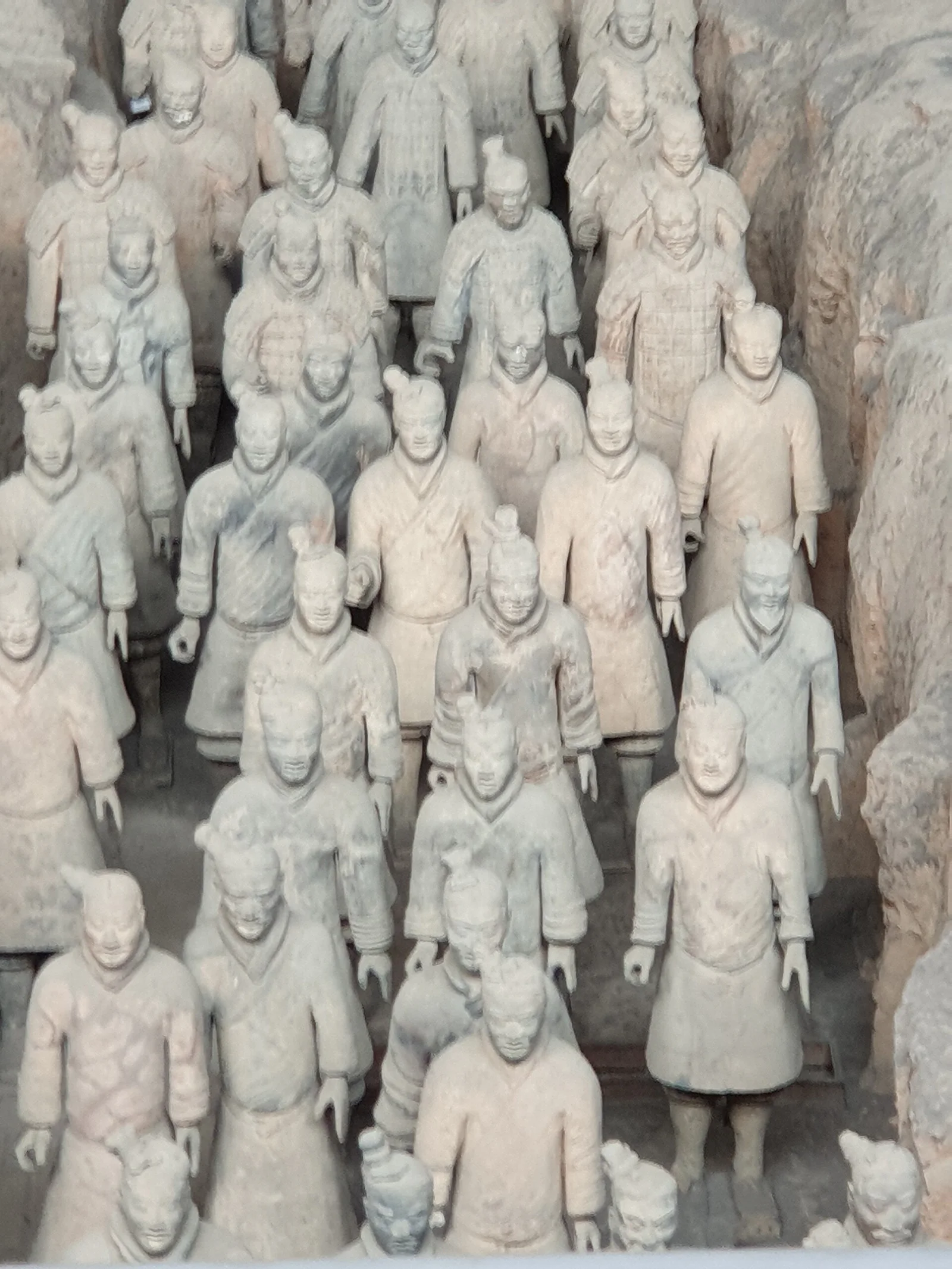
The most immediate impression conveyed by the panoramic view across Pit 1 is one of sheer scale. Ranks of warriors stand shoulder to shoulder in long earthen corridors, separated by rammed-earth partition walls that once supported a timber roof. The trench structure is clearly legible: parallel corridors stretch back from the front rank, each roughly three metres wide, creating a grid that organises the army into a coherent tactical formation. Vanguard troops face east, flanked by files of soldiers oriented outward to protect the formation's sides and rear. The spatial logic mirrors real Qin military doctrine as recorded in contemporary texts, suggesting that the arrangement was not merely decorative but strategically deliberate.
Closer inspection of the terracotta warriors themselves reveals a remarkable programme of individualisation. No two faces are identical. Hairstyles, facial hair, expressions, and headgear vary from figure to figure, reflecting differences in rank, regional origin, and military role. Generals wear double-layered armour and elaborate caps; infantrymen are more lightly equipped; kneeling archers adopt a pose consistent with crossbow use. The figures were assembled from standardised body components—torsos, arms, legs, and heads produced in moulds—then finished by hand with added clay details. This combination of modular fabrication and individual finishing allowed workshops to produce thousands of figures while maintaining the appearance of a living army.
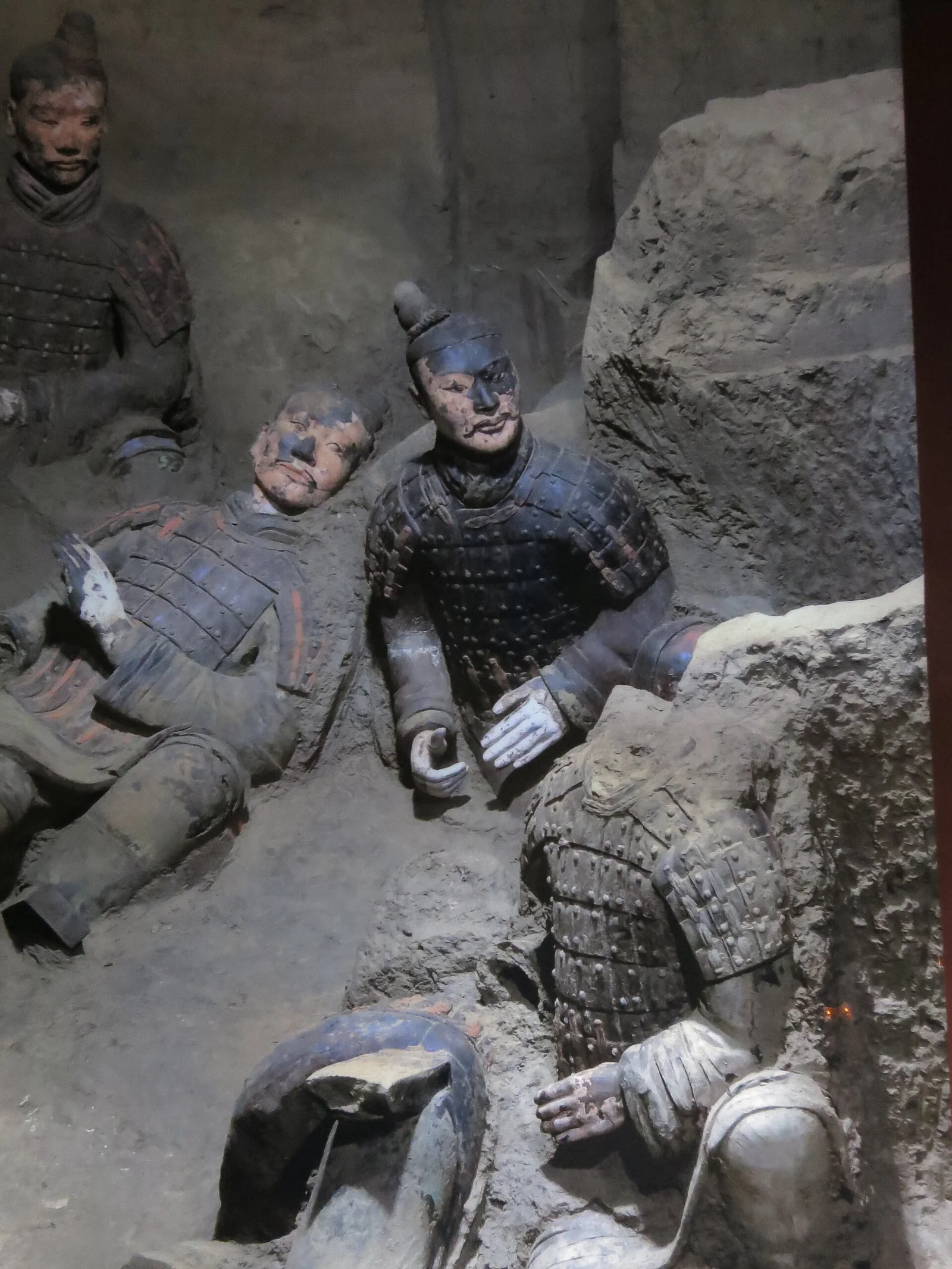
One of the most revealing aspects of the excavation is the evidence of original polychrome decoration visible on painted terracotta warriors. Traces of pigment—red, green, blue, purple, and pink—survive on some figures, showing that the army was once vividly coloured rather than the uniform grey we associate with fired clay. These pigments, applied in layers of lacquer and mineral paint, deteriorate rapidly upon exposure to air, making conservation an ongoing challenge. The painted surfaces transform our understanding of the figures: what now appears austere was originally a spectacle of colour, each warrior dressed in the hues of his unit or rank. Examining these pigment traces is essential to appreciating the full ambition of the project, which sought not merely to represent an army but to replicate one in convincing, lifelike detail.
Points of Interest
Beyond the warriors, the mausoleum complex has yielded a range of significant finds. Two half-scale bronze chariots, each drawn by four horses, were discovered in a pit west of the burial mound. These are among the most technically accomplished bronze castings surviving from antiquity, with functioning components including opening windows and articulated harness fittings. Pits containing terracotta acrobats, officials, and bronze waterfowl suggest the underground realm was intended to reproduce the full apparatus of court life, not only its military dimension.
The weapons recovered from the pits are equally instructive. Bronze swords, crossbow triggers, and spearheads were found in functional condition, many still sharp after two millennia. Chemical analysis has revealed a chromium oxide coating on some blades, a surface treatment that inhibited corrosion—evidence of metallurgical knowledge not widely recognised in Western scholarship until relatively recently. The standardisation of weapon components across thousands of items further attests to the industrial organisation underpinning Qin military power.
Sources and References
For editorial verification and public reference, only whitelisted institutional sources with a direct link to the collection, object context, or relevant museum framing were retained.
Institutional sources consulted: