Context
Florence's rise was inseparable from its economic structure. The city's wool and silk guilds generated capital that flowed into banking, and the Medici bank—founded by Giovanni di Bicci de' Medici around 1397—became the largest financial institution in Europe by mid-century. Profit alone, however, does not explain the artistic explosion. Florentine civic identity was fiercely republican in rhetoric, even as real power consolidated behind closed doors. Patronage of public buildings and devotional art served a double purpose: it honoured God and advertised the patron's virtue, a concept the humanists called *magnificenza*. In a society where conspicuous piety and public generosity were closely intertwined, commissioning a chapel or endowing an altarpiece was simultaneously an act of devotion and a calculated display of status.
Cosimo de' Medici (1389–1464) understood this calculus perfectly. He funded the rebuilding of San Lorenzo and San Marco, employed Donatello on a near-permanent retainer, and assembled a library of classical manuscripts that became a magnet for scholars across Italy. His grandson Lorenzo (1449–1492) shifted the emphasis towards philosophy and poetry, hosting the Neoplatonic circle of Marsilio Ficino and sponsoring the young Michelangelo in the sculpture garden at San Marco. Neither man held formal office for most of his career; both governed through networks of obligation in which artistic commissions were a form of political currency. The works they funded were intended to be seen, discussed, and admired—visible proof that Medici stewardship benefited the entire city.
The institutional backdrop mattered as much as individual patrons. Florence's guild system regulated artistic production, while the Opera del Duomo—the works board of the cathedral—oversaw some of the century's most ambitious engineering projects. Competitions, such as the famous 1401 contest for the Baptistery doors, created a public arena in which talent was tested and reputations forged. This competitive ecology, combined with Medici largesse, produced an artistic density unmatched anywhere in Europe. Workshops operated in close proximity, masters and apprentices observed one another's innovations, and the resulting cross-pollination of ideas accelerated technical and aesthetic development at a pace that astonished contemporaries.
What to Notice
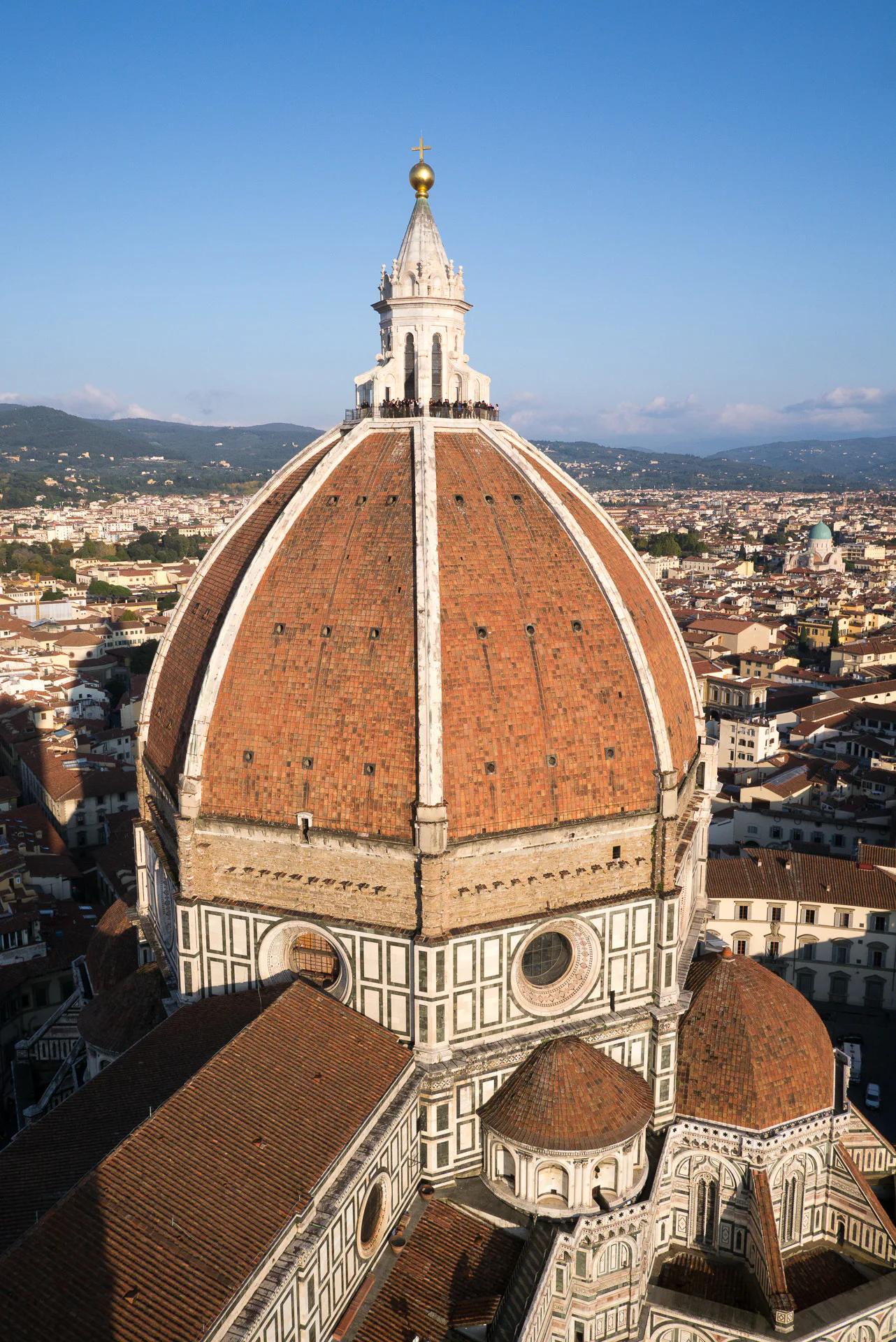
The physical fabric of Florence still registers the priorities of its Renaissance patrons with remarkable clarity. Brunelleschi's dome, crowning Florence Cathedral—the cathedral of Santa Maria del Fiore—is the most legible example. Rising above the city in a double-shelled octagonal form, the dome solved an engineering problem that had defeated builders for decades: how to span a 42-metre void without the centering scaffolding that conventional Gothic construction required. Brunelleschi devised a self-supporting herringbone brickwork technique, drawing on his study of Roman concrete vaults, particularly the Pantheon. The result is not merely structural; the dome's lantern and ribbed profile became the visual signature of Florence itself, visible from every surrounding hillside and reproduced in countless later buildings, including St Peter's in Rome. Even today, no structure in the city is permitted to exceed its height, a regulation that preserves the dome's dominance over the urban panorama.
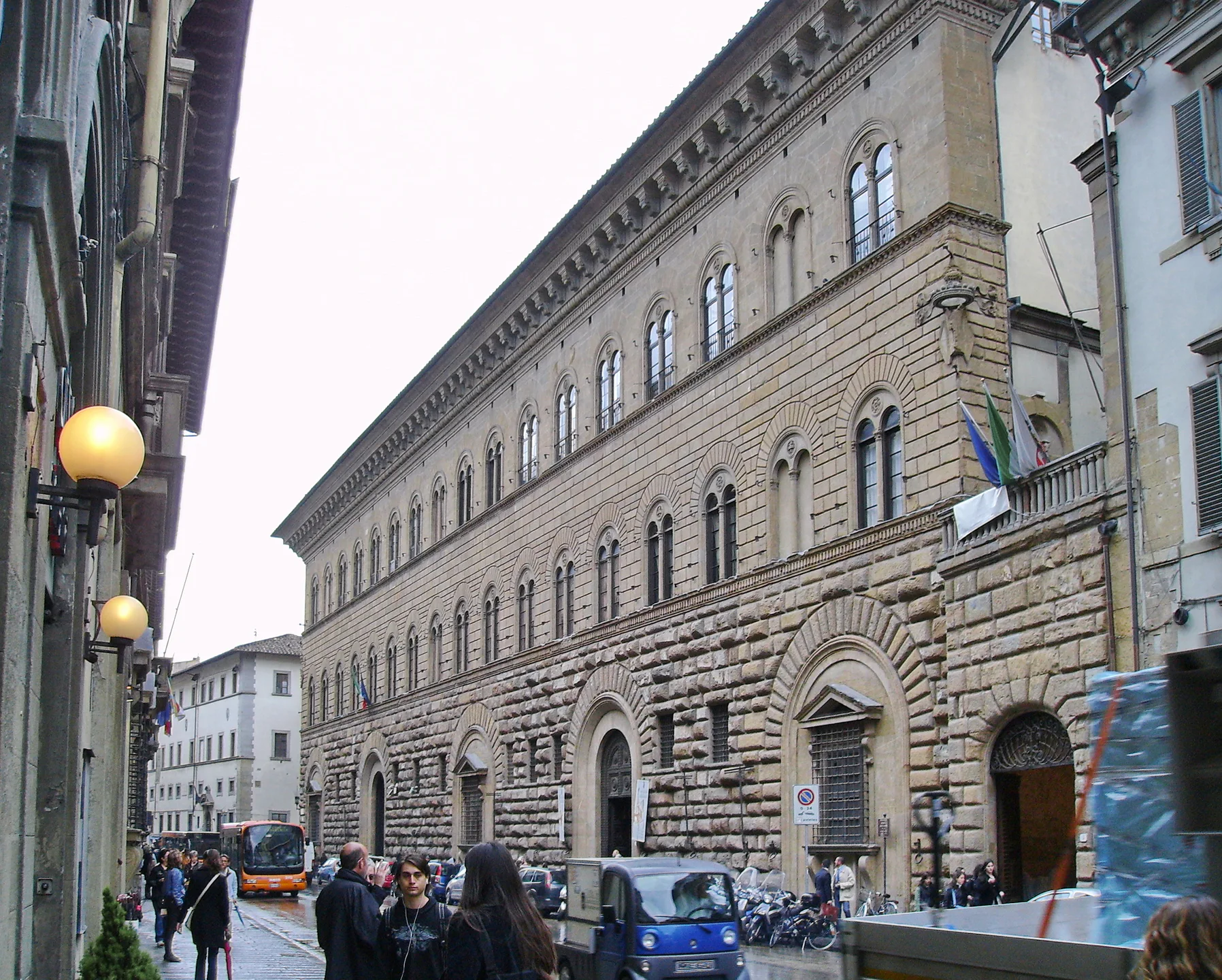
A short walk south-west from Florence Cathedral, the rusticated stone façade of Palazzo Medici Riccardi announces a different kind of ambition. Commissioned by Cosimo de' Medici from Michelozzo di Bartolomeo in 1444, the palace introduced a graduated stonework scheme—rough-hewn blocks at ground level, smoother ashlar above—that became the template for aristocratic urban architecture across Italy. The progression from rugged base to refined upper storeys was both aesthetic and symbolic, suggesting strength tempered by cultivation. Inside, the private chapel preserves Benozzo Gozzoli's fresco cycle of the Procession of the Magi (1459–1461), in which members of the Medici household appear as participants in the sacred journey, embedding dynastic self-fashioning within devotional imagery.
Equally telling is the open civic stage of Piazza della Signoria, where political authority and artistic display converged in public space. The Loggia dei Lanzi sheltered monumental sculpture; Donatello's *Judith and Holofernes* and, later, Michelangelo's *David* were placed here as statements of republican virtue. The piazza functioned as an outdoor gallery long before the concept of a museum existed, demonstrating how Florentine culture treated art as a communal possession rather than a purely private luxury.
Together, these sites reveal a city in which architecture, painting, and sculpture were not decorative afterthoughts but instruments of governance, theology, and identity.
Points of Interest
The Medici orbit extended well beyond Florence's walls, and objects from that milieu are now distributed across major collections worldwide. The Met holds significant examples of Florentine Renaissance painting and decorative arts, offering visitors outside Italy an opportunity to study workshop techniques and iconographic conventions at first hand. The Art Institute of Chicago preserves panel paintings and devotional works that illustrate the range of workshop production in the period, from intimate domestic panels to more formally ambitious altarpiece components. The Cleveland Museum of Art likewise houses Florentine pieces that repay close attention, providing further evidence of the broad dissemination of Florentine artistic ideas across later centuries of collecting.
Within Florence, the UNESCO-listed historic centre preserves an extraordinary concentration of fifteenth-century fabric. The Medici Chapels at San Lorenzo—expanded by Michelangelo in the sixteenth century—remain the most powerful statement of the family's desire to link artistic excellence with dynastic memory. Visitors moving between Florence Cathedral, Palazzo Medici Riccardi, and the Piazza della Signoria can trace, in a single afternoon, the interplay of sacred, domestic, and civic patronage that defined the Florentine Renaissance. Each site speaks to a distinct sphere of influence, yet all three are bound together by the same underlying conviction: that the built environment, thoughtfully shaped, could express and sustain the highest aspirations of a community.