Context
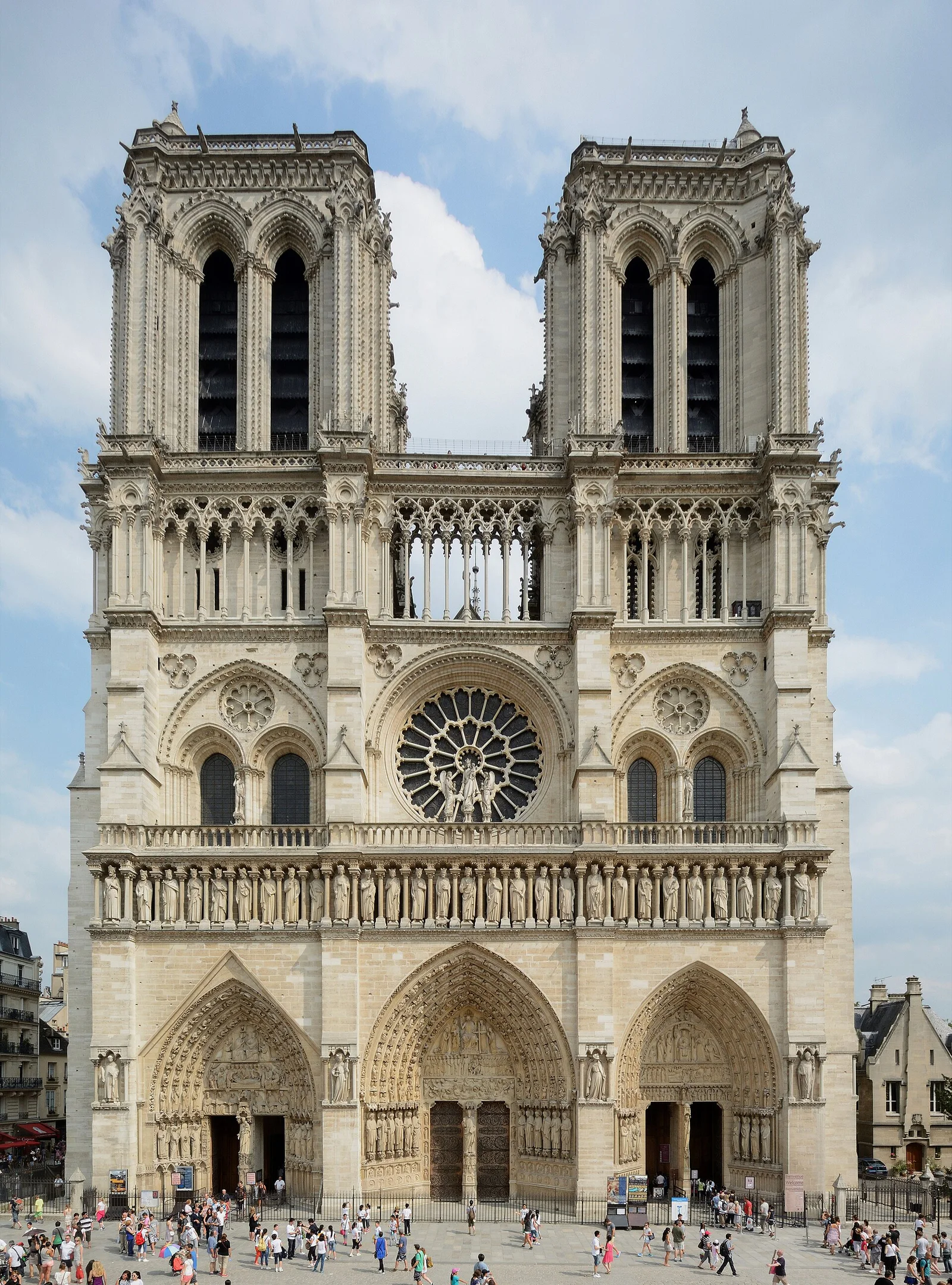
The decision to build a new cathedral in Paris coincided with a period of rapid urban growth and royal consolidation under the early Capetian dynasty. Maurice de Sully, bishop from 1160, envisioned a structure large enough to serve as the spiritual heart of a city that was becoming the administrative capital of France. Construction began at the east end — the choir was consecrated around 1182 — and proceeded westward, with the nave completed by roughly 1208 and the twin-towered west façade finished by the 1240s. The building campaign thus spanned nearly a century, absorbing successive refinements in Gothic engineering as they emerged.
Notre-Dame occupies a transitional position in the development of the style. Its six-part rib vaults and thick-walled tribune gallery belong to an early Gothic vocabulary inherited from buildings such as Sens and Laon, yet the decision to enlarge the clerestory windows in the 1220s and to add the great rose windows of the transepts in the 1250s brought the cathedral into dialogue with the Rayonnant phase pioneered at the Sainte-Chapelle. The flying buttresses — among the earliest to be designed as permanent, visible structural members rather than concealed expedients — allowed the upper walls to be opened to light on a scale previously impossible.
By the eighteenth century the cathedral had suffered significant liturgical alterations and neglect. Victor Hugo's 1831 novel drew public sympathy to its deteriorating state, and in 1844 the architects Eugène Viollet-le-Duc and Jean-Baptiste Lassus won the commission to restore it. Viollet-le-Duc's campaign, lasting until 1864, added the iconic flèche, the gallery of chimeras, and much of the sculptural detail now associated with the building. The fire of 15 April 2019 destroyed the nineteenth-century spire and most of the medieval timber roof, prompting a five-year restoration that concluded with the cathedral's reopening in December 2024.
What to Notice
The south façade of Notre-Dame, visible from the left bank of the Seine, offers the clearest single reading of the cathedral's structural logic. From this angle the full massing of the building is legible: the stepped elevation of nave, tribune, and clerestory; the great arc of the flying buttresses transmitting the vault thrust outward and downward to the massive pier buttresses; and the projecting south transept with its monumental rose window. The buttresses are not merely functional — their slender profiles and pinnacle caps were designed to be seen, turning an engineering solution into an aesthetic statement. Notice how the stone mass diminishes as the eye travels upward, creating a visual lightness that belies the enormous weight of the masonry.
Moving inside, the view along the nave toward the east end reveals the spatial ambition of the early Gothic plan. The interior of Notre-Dame rises through four distinct storeys — arcade, tribune gallery, small oculi (remnants of the original design), and clerestory — producing a vertical rhythm that draws the eye upward to the rib vaults roughly thirty-three metres above the floor. The pointed arches of the arcade are carried on cylindrical piers with engaged colonnettes, a formula that unifies the bay system from floor to vault. Light enters obliquely through the clerestory lancets and floods laterally through the transept roses, creating a shifting luminosity that changes with the time of day and the season.
The south transept interior deserves particular attention. Looking across the first bays of the choir, one can read the stained glass of the south rose in its full circular composition — a masterwork of Rayonnant tracery dating to the 1260s. The thin stone mullions radiate from a central oculus, subdividing the thirteen-metre diameter into a lattice that holds panels depicting scenes from the life of Christ and the saints. The colour palette, dominated by deep blues and reds, filters daylight into a warm, saturated glow that contrasts with the cooler grey of the limestone interior. This interplay between coloured light and monochrome stone is fundamental to the Gothic aesthetic and is nowhere more powerfully experienced than in the transept crossings of Notre-Dame.
Points of Interest
The gallery of chimeras along the upper balustrade of the towers is entirely a product of Viollet-le-Duc's restoration, not a medieval survival. These fantastical figures — part gargoyle, part literary invention — became iconic through photography and popular culture, yet they illustrate a nineteenth-century theory of Gothic completeness rather than any documented medieval programme. Visitors often confuse them with the functional gargoyles lower on the building, which serve as rainwater spouts.
The cathedral's timber roof, known as "la forêt" because of the density of its oak framing, was one of the oldest surviving medieval timber structures in Paris before the 2019 fire. The restoration replaced it with a new oak frame using traditional carpentry techniques, a decision that sparked debate between advocates of historical fidelity and those who favoured modern materials. The restored flèche reproduces Viollet-le-Duc's design, including the copper statues of the twelve apostles that were fortuitously removed for conservation shortly before the fire.
Notre-Dame's west façade, with its three portals, gallery of kings, and twin towers, established a compositional template that was repeated — with local variations — at Amiens, Reims, and dozens of smaller churches across northern France and beyond.
Sources and References
For editorial verification and public reference, only whitelisted institutional sources with a direct link to the collection, object context, or relevant museum framing were retained.
Institutional sources consulted: