Context
The Nasrid emirate of Granada (1238–1492) was the last Muslim polity on the Iberian Peninsula, a small but culturally productive state that survived by diplomacy, tribute, and the strategic exploitation of its mountainous terrain. The Alhambra — from the Arabic *al-Qalʿa al-Ḥamrāʾ*, the Red Fortress — served as both the seat of government and the private residence of the ruling dynasty. Construction began under Muhammad I ibn al-Ahmar in the 1230s, but the buildings that define the site today belong largely to the reigns of Yusuf I (r. 1333–1354) and Muhammad V (r. 1354–1359, 1362–1391). These two sultans were responsible for the Comares Palace, centred on the Court of the Myrtles, and the Palace of the Lions, with its celebrated courtyard of marble columns and its central fountain.
The complex sits on a narrow plateau overlooking the Darro valley, with the medieval quarter of the Albaicín spread across the facing hillside. To the east, the Generalife — the sultans' summer retreat — occupies a separate ridge connected to the main enclosure by a walled passage. After the Christian conquest of 1492, Charles V inserted a massive Renaissance palace into the precinct, and successive restorations, some sensitive and some destructive, continued into the modern era. The Alhambra was inscribed on the UNESCO World Heritage List in 1984, together with the Generalife and the Albaicín, in recognition of its outstanding universal value as a testimony to Nasrid civilisation and to the broader cultural exchanges of medieval Iberia.
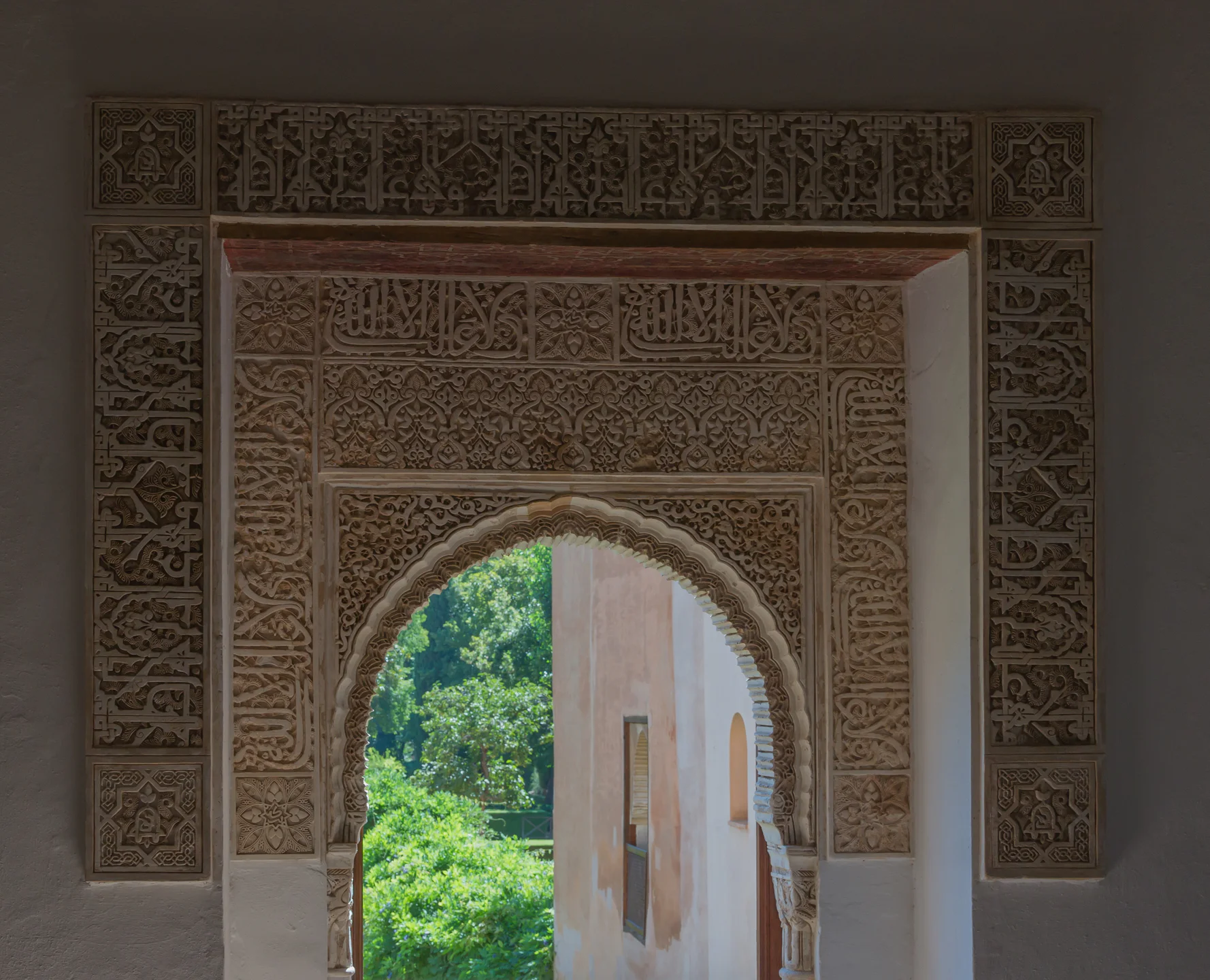
What makes the Alhambra exceptional is not its scale — it is modest compared with contemporary Mamluk or Timurid projects — but the intensity and coherence of its decorative programme. Every surface is articulated: carved stucco panels carry Quranic verses and dynastic poetry; ceramic tile dados deploy complex geometric tessellations; wooden ceilings reproduce cosmological diagrams. The architecture is conceived from the inside out, privileging the experience of the inhabitant over the impression of the passer-by.
What to Notice
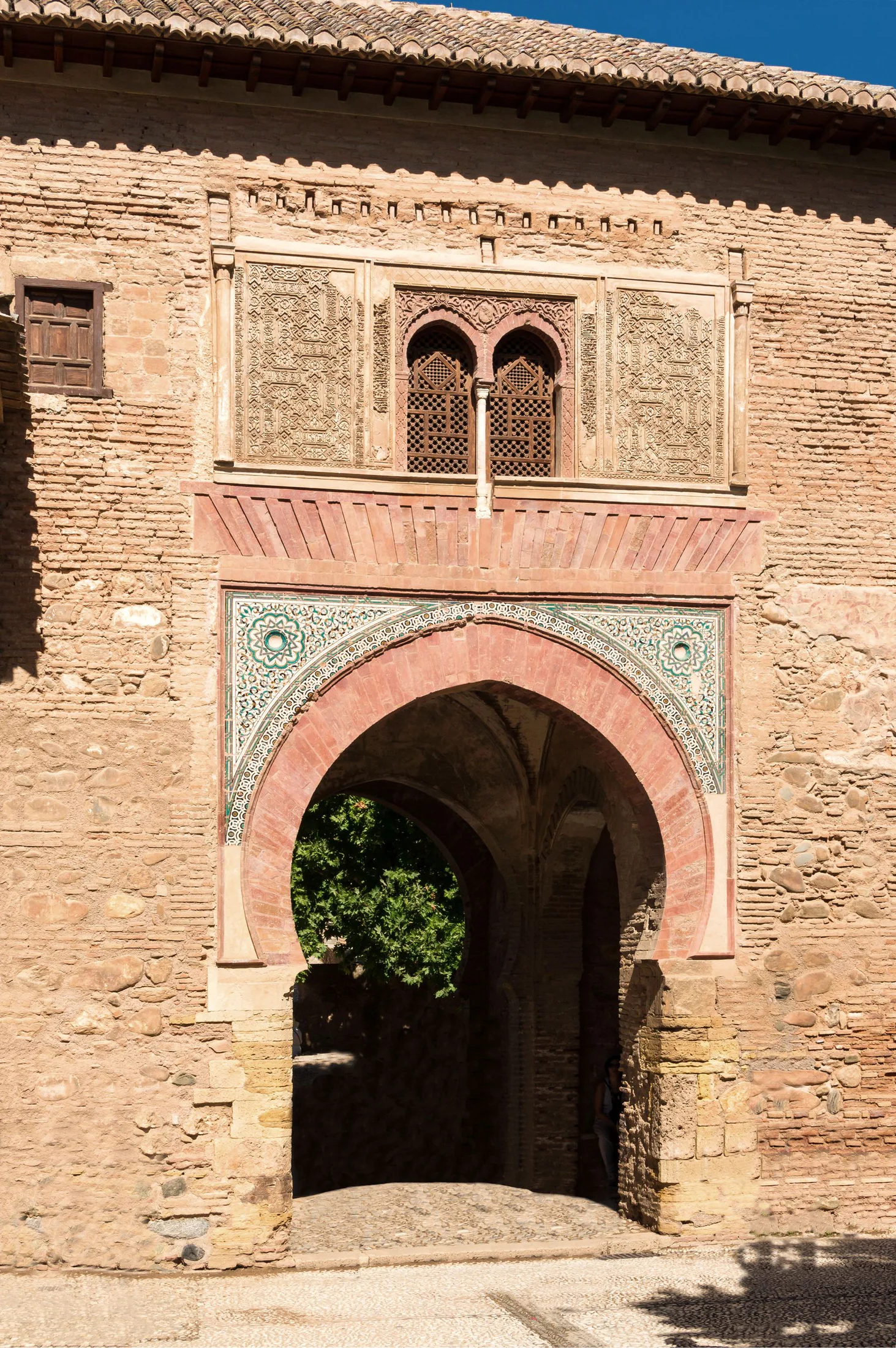
The Alhambra rewards attention to thresholds. The **Puerta del Vino**, one of the oldest surviving gateways in the complex, offers a concentrated lesson in Nasrid architectural language. Its façade compresses into a single vertical composition the key elements that recur throughout the palaces: a horseshoe arch framed by an *alfiz* (rectangular moulding), panels of carved stucco with vegetal and epigraphic motifs, and a field of polychrome tilework at the base. The red brick and the warm ochre of the stucco give the gate its characteristic warmth, while the calligraphic bands — invoking divine blessing and royal authority — remind the visitor that ornament here is also text. Standing before the Puerta del Vino, one can already read the grammar that will govern every room beyond it.
From the **Generalife gardens**, the Alhambra reveals its other face: a fortified silhouette of roofs, towers, and crenellated walls rising above dense vegetation. Seen from this vantage, the various roofs and towers of the complex compose a layered panorama in which the defensive and the palatial coexist. The Torre de la Vela, the Torre de Comares, and the smaller watchtowers punctuate the skyline, their plain exteriors giving no hint of the ornamental richness within. This contrast between austere exterior and lavish interior is fundamental to Nasrid aesthetics and to the broader tradition of Islamic palatial architecture: the garden is the threshold between the public world and the private paradise.
Water is the connective tissue of the entire ensemble. In the Comares Palace, the long rectangular pool of the Court of the Myrtles mirrors the façade of the throne-hall tower, doubling its height and dissolving the boundary between architecture and reflection. In the Palace of the Lions, four channels radiate from the central fountain, evoking the four rivers of paradise described in Islamic cosmology. At the Generalife, the Acequia courtyard channels a narrow stream between rows of arching water jets, creating a corridor of sound and coolness. Throughout, water serves simultaneously as climate control, acoustic design, and metaphysical symbol.
Points of Interest
The Alhambra's influence extended well beyond Granada. Nasrid craftsmen produced luxury textiles, metalwork, and ceramics that circulated across the Mediterranean; the so-called Alhambra vases — large lustre-ware vessels with wing-shaped handles — are among the most celebrated objects of Islamic Spain, and examples survive in major collections. Nineteenth-century travellers and artists, from Washington Irving to John Singer Sargent, transformed the Alhambra into a touchstone of the Romantic imagination, and Owen Jones's meticulous chromolithographic studies of its ornament, published in 1842–1845, directly shaped Victorian theories of polychromy and pattern design.
The view from the Alhambra towards the **Albaicín** — the old Moorish residential quarter cascading down the opposite hillside — underscores the urban dimension of the site. The two hills face each other across the narrow Darro gorge, and the visual dialogue between palace and city is an essential part of the Alhambra's spatial logic. The Albaicín retains its medieval street pattern, its *cármenes* (walled garden houses), and fragments of Nasrid domestic architecture, offering a civilian counterpart to the palatial splendour on the Sabika.
Sources and References
For editorial verification and public reference, only whitelisted institutional sources with a direct link to the collection, object context, or relevant museum framing were retained.
Institutional sources consulted: